SMC 2026-06-28
Hi,
Over the past two weeks, we have been exploring the remarkable range of revenue opportunities enabled by BacTech's patent-pending Zero Tailings technology — from magnetite for the steel industry to fertilizer for agriculture. This week, another door opened.
Mid-week, I had a conversation with Nicholas Scott Forbes from Environmental Communications about BacTech and what we are trying to accomplish. When I mentioned that bioleaching and element extraction leave behind essentially just sand, Nicholas introduced me to something I had never considered: the global sand crisis, and the criminal networks that have emerged around it — known as the "Sand Mafia."
It turns out that construction-grade sand is one of the most in-demand and undersupplied natural resources on the planet. And not just any sand — the construction industry requires rough, angular sand for use in concrete and building materials, as opposed to the round, smooth sand found on beaches and riverbeds, which is largely unsuitable for modern construction standards.
This adds yet another potential revenue stream to an already impressive lineup under Zero Tailings. Whether our residual sand is rough or round remains to be determined — but it is absolutely worth finding out.
Cheers,
Ross Orr
President & CEO
Drugs, counterfeiting, and... SAND?
It turns out that the third-highest grossing criminal activity in the world is illegal sand mining.
I know. It sounds like a joke. "Have you seen the Sahara? Have you seen the Australian Outback?"
That was my first reaction, too.
But here is the scientific twist that turns this into a global crisis: Desert sand is useless.
Wind erosion makes desert grains perfectly round and smooth. If you try to build with them, they slip past each other like marbles. They don't lock together.
To make concrete, glass, and the silicon chips in your phone, you need "angular" sand. Rough, jagged grains that can only be shaped by water. You need sand from riverbeds and ocean floors.
And that is where the "Sand Mafia" comes in.
We are currently consuming 50 billion tons of sand every year. It is the second most consumed natural resource on the planet after water.
Because we can’t use the desert, we are stripping the planet's beaches and riverbeds naked.
The demand is so desperate that it has birthed a criminal empire. In fact, illegal sand mining is now estimated to be the third-largest organized criminal activity in the world by revenue, ranking just behind counterfeiting and drug trafficking.
In countries like India, Morocco, and Cambodia, these "Sand Mafias" operate with cartel-level violence:
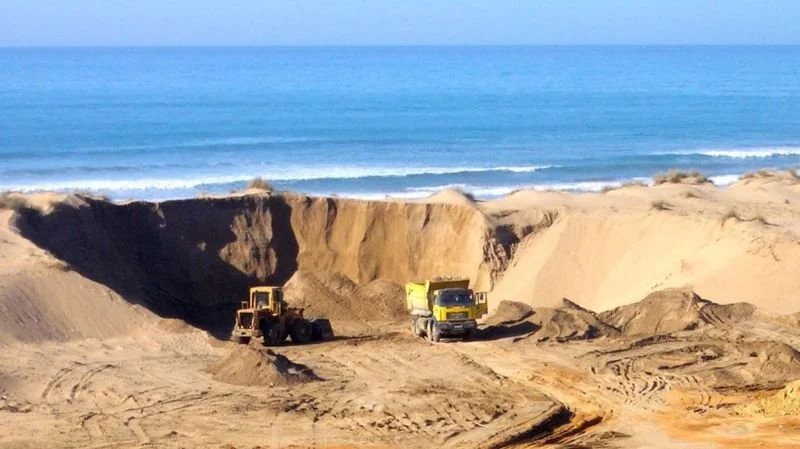
They steal entire beaches overnight. (In Morocco, sand is stolen from one beach to build hotels on another).
Journalists, activists, and officials have been burned, beaten, and run over for asking questions.
By vacuuming up the ocean floor, they destroy fisheries and leave coastlines defenceless against rising sea levels.
China, the world's largest consumer of sand, famously used more sand between 2011 and 2013 than the United States used in the ENTIRE 20th century.
So, the next time you see a skyscraper, don't just see concrete. See the ocean floor, standing vertically, thousands of miles from where it belongs.
Sources: UNEP-WCMC Report, "Sand and Sustainability"/Based on comparative data from the Global Financial Integrity reports and SandStories (Luis Fernando Ramadon), estimating the trade at ~$200B-$350B annually.